
After a 500km tour of Switzerland and Northern Italy, I think it might just be the best flat-bar road bike I’ve ever ridden and yet one of the most inconvenient folding bikes around…
Summary of the Tern P20:
| Pros | Cons |
| Fast hybrid/road/touring bike with excellent ride characteristics | Fold down size is just too big – for cars, planes and trains |
| Integrated accessories augment it into a true tourer | Almost as difficult to transport as a full size bike |
| Wide gear selection and quality components | Not exactly cheap |
| Overall great design and build quality | Vulnerable, breakable key components – magnetic clasp |
| Sleek and sporty looks | Includes some really weird design choices |
Summary of the Tern C7
| Pros | Cons |
| Solidly functional commuter with the ability for more | Alternatives are more tempting? |
| Widely available 20″ tyres and tubes, relatively few proprietary parts | Pesky, breakable ‘magnetix’ clip |
| Half the price of a Brompton, for arguably a better cycling experience | Fold isn’t all that small |
Tern Bikes
Tern Bicycles make an intriguing range of bikes, broadly covering three categories:
– Folding Bikes
– Compact electric bikes
– Electric Cargo bikes
– The coolest damn minivelos I’ve ever seen (although sadly only available in Asia, it seems)
I’ve been lucky enough to spend some quality time with a couple of their folding bikes, the commuter focused Link C7 and the…I don’t know what focused…Eclipse P20. In fact I’ve ridden the P20 several hundred kilometres across Switzerland, Northern Italy and Eastern France on a variety of terrains. Overall, the P20 is a incoherent mixture of brilliance and confusion, while the Link C7 is a solid and likeable commuter with the capability for more.
While I’m going to give a detailed breakdown of my experiences with these two bikes, a lot of the same things would be applicable to other models in the Tern folding bikes range, such as the Eclipse X22, the Verge X11 and the Verge P10, as well as pretty much the whole Link range (Link A7, B7, C8, D8) so if you’re considering those models, read on!
The Tern Folding Bike range
Many mid-size bike brands cater only to a particular market segment or price point. Cervelo only really make expensive, drop-bar road bikes. Carrera’s (non-electric) product line tops out at £925, focused firmly on the mass-market.
Mid-size and niche brands leave it to a handful of the big bike brands like Specialized to cover the whole market range: (The Specialized Sirrus 1.0 is a basic flat bar hybrid costing about £/€/$ 350-450; while the Specialized Aethos Dura Ace is a casual £13,200, ($17,400! €16,000!) which is actually the same price as a brand new Volkswagen Up! hatchback car).
But what if they didn’t? That seems to be what Tern is going for with their folding bikes. Their cheapest bike at the time of writing is the Link A7, coming in under £/€/$500. At the top of their range, the Eclipse X22 comes in at £2500, making it pretty much one of the most expensive production folding bikes out there. And their range covers pretty much everywhere in between those.
Dividing up their folding range and making sense of it is a little tricky – and their website isn’t a huge help.
They have:
– commuter/casual use folding bikes that are either really cheap or really expensive
– light-ish, expensive-ish mid-range folding bikes
– ultra-light expensive road-oriented bikes with carbon components
But arguably it makes more sense to divide them up by wheel size. Again, it gets pretty weird here. They have:
– 20″ (406) wheels – common to BMX and other folding bikes
– 20″ / 21″ (451) wheels – very rare wheel size mostly seen in recumbents
– 26″ wheel bikes – the common standard for older mountain bikes
I guess in the folding bike market, you really have to do something to differentiate yourself from the ubiquitous £1300ish Brompton. So selling commuter bikes at £600 or at £2200 kindof makes sense. Maybe.
The Tern Eclipse P20
What is it?
The Eclipse P20 is a road-oriented 26″ wheel bike that sits towards the top of the Tern folding range at £1500ish. I got mine from the lovely chaps down at Richmond Cycle Centre. They are Tern and folding bike specialists, and I would highly recommend them based on my experience of using them. I paid for this bike with my own money so I can be as rude as I like in this review.
The frame and the ride quality:
The frame is a really chunky alloy deal (7005 Aluminium to be precise) – by chunky, I don’t mean in weight. It’s just a big thick tube, with the folding mechanism in the middle of it, and a 6061 aluminium fork. So, its basically a fairly standard mid-high end alloy frame, apart from it being one thick tube instead of a double triangle like a non-folding bike. Interestingly, as far as I can tell the frame is identical to the frame on the X22 – the P20’s much more expensive sister. Something to consider if you’re looking at that more expensive model. The lower-grade Eclipse D16 loses the alloy fork, and get Hi-Ten steel instead which will add a fair bit of weight.
The frames on the Verge range appear to be almost identical, except built around smaller wheels, so my analysis should apply to them too.
The usual fear with folding bikes that is in terms of ride, they feel flexy, noodley, or consciously ‘like a folding bike’. I didn’t have that experience with the Tern at all. The frame actually feels very stiff, possibly even overbuilt.
The frame actually feels very stiff, possibly even overbuilt.
I am a low-bodyweight rider, but even in out-of-the-saddle climbs it felt stiffer than my conventional alloy road bike. To its credit, this didn’t actually make for particularly harsh ride like you get with some alloy frames. According to Tern, it is a “high-performance road bike” that is “engineered for speed”. But the technical info also says it is suitable for a rider up to 105kg, and still with capacity for 15kgs of luggage. On one level, they’ve done an impressive job in making a tank of a frame feel light, stiff and strong on the road. And on another level it’s another confusing bit about this bike that leaves me wondering “is this frame built for a road race, or for a fatty picking up, like, 15 litres of beer from the supermarket?”
is the frame for built for a road race, or for a fatty picking up, like, 15 litres of beer from the supermarket?
The wheels
OK it gets kinda weird here too. The Eclipse range has 26″ wheels. Really cool ones with 24 holes and wacky paired spokes. It certainly makes it look fast.

There’s a lot to say about these wheels, because they really make and break this bike. They’re simultaneously the greatest strength and weakness of this bike, and it is the wheels above all that illustrate the compromise between a folding and a full-size bike.
26″ used to be the mountain bike standard and is still probably the most common wheel diameter worldwide. That’s to say, these are not conventional folding bike wheel-size, they are a long-standing full-size bike standard. Most folding bikes use much smaller 20″ or 16″ wheels, to enable a small folded package. It’s the 26″ wheels that make the folded Eclipse a veritable giant next to a folded Brompton.
these might just be the lightest 26″ wheels around
But these wheels specifically might just be the absolute lightest 26″ wheels on the market. How weird is that? I actually took the rotors and tyres and cassette off and weighed them….and then lost the scrap of paper I wrote that weight on. I really can’t be bothered to do it again, but they are light light wheels. I’m sure somebody somewhere has built some carbon 26er with lighter ones but if there are lighter OEM 26er wheels out there they’re certainly not widely available. If someone knows the weight, please do comment below.
The 26″ wheels make this bike feel pretty much exactly like a full size bike. Unfortunately, that includes when its folded.
The 26″ wheels make this bike feel pretty much exactly like a full size bike. Unfortunately, that includes when its folded.
When riding, I told myself I could feel the slight lack of momentum on these compared to 700c road bike wheels. My Strava does suggests that they are a little slower downhill, and certainly topped out at a lower speed on a steep descent. I don’t really care about my top speed, and that could be due to many other factors anyway. But on the uphill my Strava data actually suggests the Tern rolls at pretty much exactly the same speed as my alloy road bike, which is marginally lighter overall, but has slightly heavier 32-spoke 700c gravel disc brake wheels. I didn’t really notice any huge ride comfort differences compared to 700c wheels either. That’s to say, performance wise, this folding bike doesn’t give up much speed at all to a low-mid range aluminium drop-bar road bike.
My Garmin sent me down some muddy off-road stretches – and it got even more interesting here. I don’t really do off-road and don’t really enjoy it. Weirdly, the Tern and its lightly built 26″ wheels felt much more confidence inspiring than my full size non-folding bike with gravel-ish wheels. If you wanted to, I believe you could fit decently fat 26er tyres on this and do more off-road stuff, or even stick in a set of 24″ wheels with really fat tyres and make a proper off road foldie.
So, performance-wise, the 26″ wheels are great. They are as light as anything, and have no real performance downsides compared to a 700c wheel unless you’re racing competitively.
The trouble with the 26″ wheels is threefold:
– Tyre selection
– Folded size
– Folded strength and adjustment
Tyre selection:
26″ is probably still the most common tyre size around, but the majority of 26″ tyres are designed for off-road use. The Eclipse comes with Schwalbe’s Kojak tyres in a 26er 35mmish size. These are slick road tyres with a cool name and a sleek look. Trouble is, the data shows they are not that fast at all. The 700c Kojak’s are some of the worse-performing touring/road tyres available. And its not just rolling resistance – their grip and puncture protection is nothing special either. And despite that, they are still some of the fastest 26er slick/road tyres. In other words, some of the low performing 700c tyres are still just about the best 26er road tyres because there just aren’t all that many thin, slick 26er tyres out there. That’s actually a quite a serious limitation on the bike. Continental Grand Prix and Schwalbe One tyres might be worth a look though.
The plus side is that if you trash a tyre anywhere in the world, there will always be 26er tyres and innertubes for sale somewhere.
Wheels/Folded size:
It is, fundamentally, the 26er tyres that make this bike a big folded package. Its 89cm at its longest point. The Verge P10 uses smaller 451-size wheels, and that brings it in at 80cm. That 9cm can really, really matter when you want to travel with it by plane or train because the size limit for folded/boxed bikes on many European trains is 85cm. The Eurostar or the TGV trains in France, for example. That 9cm is the difference between hopping on a train care free and ‘might get away with it, but might be forced off the train and have to rebook/hitchhike/miss your connecting flight’. On normal trains, you’re unlikely to come across a train guard whipping out a tape measure, but it certainly could happen. But when it comes to some trains, like the Eurostar….well I’m going to try it anyway, but because the Eurostar actually X-rays your luggage like the airport, but the 85cm is a strict limit – it likely won’t fit through the X-ray machine if it is longer so it would be hard to get away with. If you’re not sure which size wheel to go for, I suggest you do some real research on luggage size limitations where you plan to go.
For this reason alone, if I could change it now I would choose one of their 451 wheel size bikes instead. I have also travelled with the C7 quite a bit now, and it is just SO MUCH EASIER to use, carry and transport as a folded bike. And here’s a real kicker. The Eclipse P20 doesn’t fit in a hatchback.
Here’s a real kicker. The Eclipse P20 doesn’t fit in the boot of a hatchback.
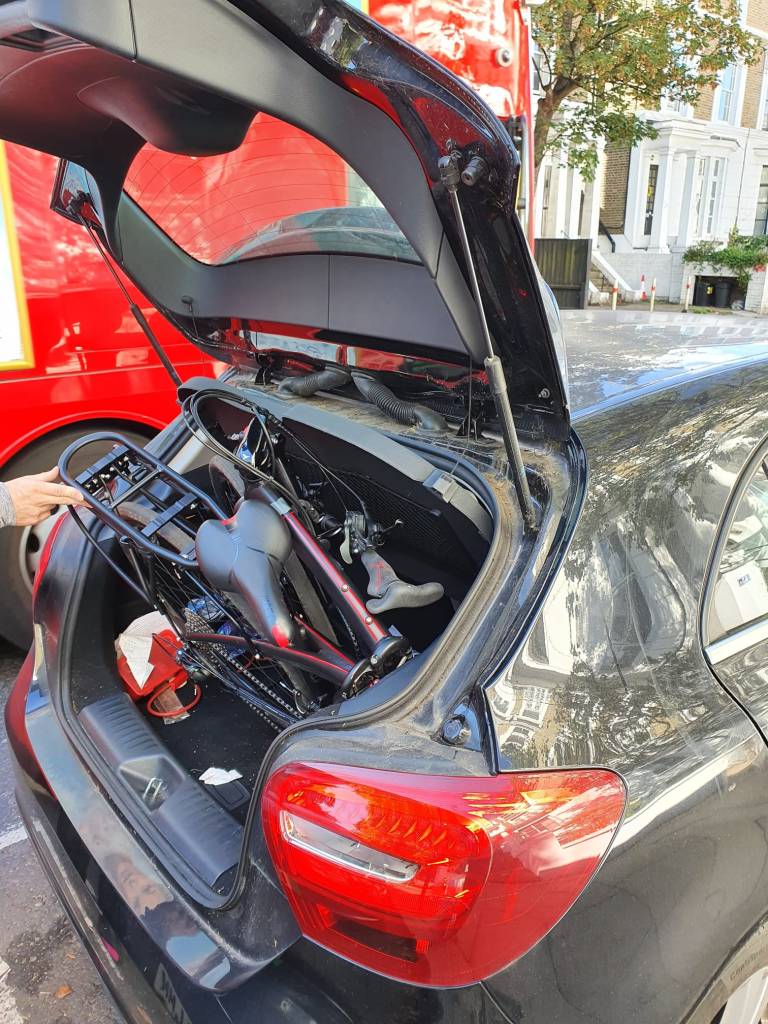
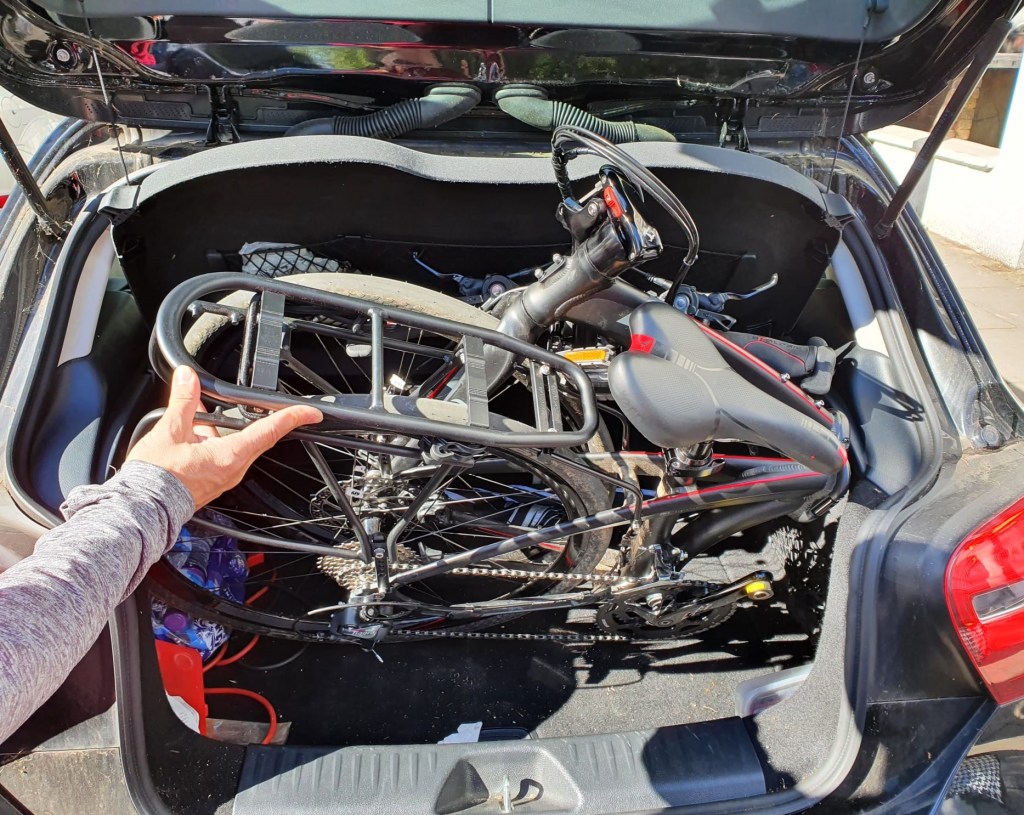
Yep. The folded P20 just won’t go with the seats up. (It can with the rear seats folded down). For reference, this is a [European model] 2016 Mercedes A Class – which surprisingly has one of the largest boots (trunk if you’re American) of any vehicle in its class. Sure, if you’ve got a big estate, or an SUV or an American vehicle you might be fine. But if it doesn’t fit in the A-Class, it’s not going to fit in a lot of other very popular vehicles like the Toyota Prius or VW Polo. For a lot of people this is going to be a major downside or even a deal breaker. It’s basically no easier to squeeze the Tern P20 into a car than it is to squeeze in a full size bike. The C7 does, just about, squeeze in to the A Class but it’s very tight – so it is far from a guaranteed fit in many other hatchback cars – especially hybrids and EVs that tend to sacrifice some boot space to fit the batteries.
Strength and adjustment:
I flew this bike out to Milan from London (more on that later). Those superlight, 24-spoke wheels had become whacked badly out of true during transport. It was just-about rideable for my short, first day in Italy. (if it were a rim brake bike, it would not have been.) I then spent a good hour or more on my first night in Italy truing the wheels with a spoke key in a sultry hotel room, instead of, you know, eating Parma ham and drinking Pinot Grigio like I wanted to. I think a 32 spoke wheel would have survived the transport better, and it made me really question the wisdom of having such lightly built wheels on a folding bike that is likely to get a few knocks. Moreover, that paired-spoke design that makes it look so cool means there is very high spoke tension and there are long gaps in the rim between spokes. That meant it was a hard task to straighten and true the rim, much harder than on a 32 spoke wheel. I am a competent wheelbuilder – I’ve built quite a few wheels from scratch and sortof know what I’m doing, and I still found it a chore to fix these. If you’re not a keen mechanic or wheelwright and you try to fly with this bike, you might spend your travels looking for someone who is.
Anecdotally, though, I have corresponded with a Tern dealer in the US who said he also had doubts about such lightly built wheels, especially as Tern doesn’t make them easy to buy after-market – but in years of selling them he has had to do very very few warranty replacements on these.
The Components:
The componentry on the P20 is another slightly odd mix.
Gears:
The gears groupset is Shimano Tiagra 2×10, with FSA cranks. By and large it just works. Tiagra is Shimano’s mid-range road/hybrid gears set. Sitting below the slightly fancier 105 and even fancier Ultegra in the Shimano product range. Although it sounds like impotence medicine, Tiagra is so good these days that its hard to see the rationale for 105 or Ultegra for the majority of riders. Shifting was smooth, and the gear range was fine. I went up and down a couple of really steep hills in the foothills of the Swiss alps and never came close to running out of gears. I did drop the chain early on. But that was down to indexing and cable stretch. Once it was set up properly, it did exactly what I want from gears – I just never really thought about them again, and never felt like they were holding me back compared to my 105 equipped bike. The main difference between the P20 and the upper model the X22 seems to be that the X22 comes with carbon cranks and Ultegra, more for weight-savings than performance I assume. I really struggle to see the rationale for that setup over the P20. The cranks are pretty vulnerable to impacts when the bike is folded, so I’m not sure how great an idea the carbon is, and with a sturdy aluminium folding frame I don’t think the performance boost of ultegra is ever going to be material.
Brakes:
Holy hydraulic batman? Yes. Tektro Auriga hydraulic disc brakes, on a folding road bike. It seems like a very odd choice to me. I’ve actually never used hydraulic brakes before. They’re more of a mountain-bike thing. They are extremely good at stopping the bike it is true – but perhaps almost too good. They are brakes designed for aggressive downhill riding on a 29er, suddenly applied to a light-weight 26er hybrid and that makes it very easy to lock up the wheels. I adjusted to them somewhat quickly but they seem really overkill, with slight touches on the lever slamming the bike to an abrupt stop. Rim brakes or mechanical discs would have been fine surely? The real question I have about them is actually for travel though. Being a folding bike, you’re likely going to be taking it places or flying with it. I choose cable-operated brakes on touring bikes because it is relatively easy to replace a cable without special tools and so on. The hydraulic and gear cables stick out all over the place in the folded position, and I feel like they’re begging to get snagged or damaged at some point. And then it’ll be a trip to a bike shop for a relatively expensive hydraulic repair, rather than slipping in a new cable. The hydraulic brakes are incredibly effective, but it’s extra weight, extra cost and extra complexity for no obvious benefit.
*UPDATE* my exact fears here materialised. I don’t know whether it was the clip on mudguards or the transit to the airport, or the flight itself – but on my last trip, the hydraulic cable became damaged and started leaking hydraulic fluid. Thankfully this was on the way home, so is just an annoyance I can fix at leisure. If this happened on the way out – welcome to spending your first day of travel looking for a repair shop able to do a hydraulic swap.

That weird handlepost/stem/thing:
Like the brakes, this is another weird choice. Syntace’s unique adjustable stem-riser thing is a bit of really clever bike tech that allows a range of handlebar positions, height and reach adjustments…but I can’t quite see the point of it or what it adds to a folding bike besides cost and complexity. It all works though. The C7, noticeably, skips this and has a simpler handlebar clamp. The bars themselves were very wide (for me at least) and I chopped a few centimetres off each end to make them more comfortable for my shoulder width.
Touchpoints:
The grips are rubbery ergon things on the end of the very wide flat bars. They’re fine, and noticeably nicer than on the C7 or the cheaper Terns. Aesthetically, they just look straight off a German-dad bike, which is a bit odd and doesn’t fit the whole ‘folding high-performance road bike’ thing but are reasonably comfortable for my hands.
The pedals are again, kindof odd. They are dorky, flat, solid plastic ones, but with a neat trick up their sleeve. With a squeeze of two buttons, the right hand pedal pops out to make the folded package smaller. They are very easy to use and quality seems fine, but again, other than the removable bit they seem straight off a shopping bike. After testing, I immediately replaced them with MKS EZY SPD pedals which are also removable, but allow use of SPD shoes.
The saddle is a fairly padded, dorky looking thing that claims to be unisex. Actually, I have been pleasantly surprised by it, and after lending it out to a female she said it was ‘OK’ for her anatomy too. Sample size of 2, but basically positive. The one really nice feature it has is that it has a little clip on the back where you can slide in the removable pedals! For my trip in Italy I swapped in my much-hated Brooks C17. If you were looking to save some grams on this bike, the saddle would be an easy place to do it, with something like a Selle Italia Flite saving you several hundred grams for a small financial outlay. I stuck with the stock saddle for a jaunt across Eastern France and I was happy with it. Like the grips, the P20 saddle is a little bit fancier than the one on the C7 – although that is perfectly serviceable too.
The folding mechanism….oh the folding mechanism…
The folding mechanism itself on the P20 feels rock solid and is easy to use. The first couple of times it might seem complicated, but it’s really not. I’ve actually found the easiest way to unfold, rather than methodically going through it step by step, is to spring it apart with a careful yank, all in one manoeuvre. It only takes 15 seconds all in all, and the seatpost is premarked with numbered lines, so it is easy to get your saddle height consistent. It takes a little longer to fold down, but still only 30 seconds or so. It’s a highly engineered and precisely manufactured hinge and clamp that works well every time, doesn’t squeak or shimmy, and hasn’t needed any adjustment in many kms of riding.
The folding mechanism on the C7 is a little more basic than the P20, but still feels very good and hasn’t caused any problems. The C7 seatpost lacks the numbered adjustment lines (although it’s easy to draw or scratch one on yourself).
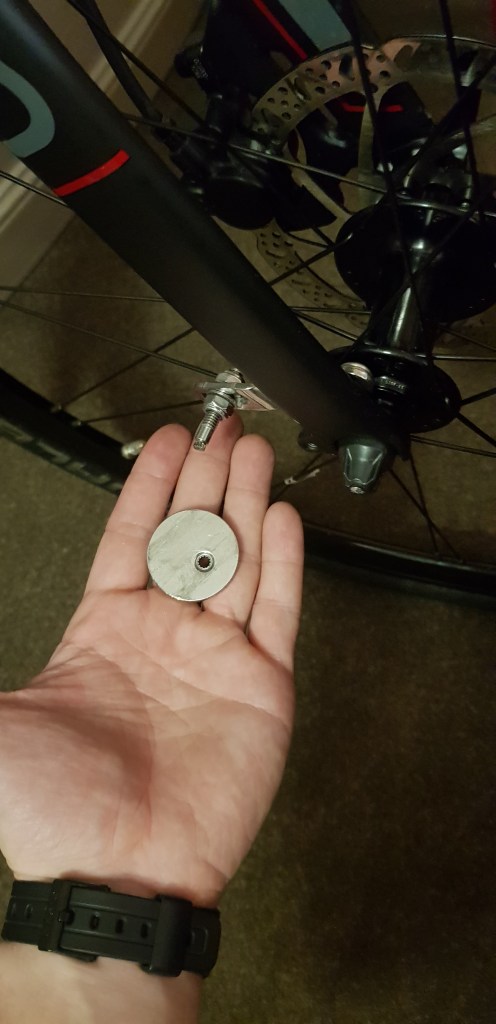
But for both bikes, we have another massive downside here in the fold. When folded, the bike is held together by a little magnetic plate connecting the rear dropout with the front fork, which Tern calls ‘Magnetix’. This sucks, and is a terrible design. It relies entirely on a little magnetic plate on a vulnerable projecting bolt to hold the whole bike together when folded. It does not hold the bike together well – the bike sometimes spontaneously opens itself. If the magnet slips off the alignment, it scratches up your fork. And when I flew with the C7 and the P20 the magnetix actually broke on both bikes! What is really disappointing about this is I’ve seen a review somewhere from like….2014? saying exactly the same thing. It sucked then and it still sucks now and Tern still haven’t come up with a better design. Of all the weird design choices Tern made in this bike, this seems like the weirdest one of all. It is just so strange to me that they would come up with such complicated integrated design on handlebars, a very well-engineered fold in the frame….and then have this crappy little magnet to hold it all together. It is like a lazy afterthought.
Ride position and adjustment
This is a strong point of the bike – it’s very adjustable in many directions for a huge range of riders, and the single main tube design of the frame means standover height will be a non-issue for basically any adult. Depending on your body proportions you might not be able to dial down an ultra-aerodynamic position, but I think almost anyone within the range of 145cm – 200cm height will be able to at least get a comfortable and efficient position on the p20 and it may well be ‘workable’ for people beyond that. It’s easy and quick to adjust between riders and I had no issues repeatedly swapping the bike between myself and a shorter female rider.
The C7 might be a little more limiting if you’re very tall though. The wheelbase is a little shorter and it is a smaller wheeled, twitchier bike with a bit less adjustability. Knees can feel quite close to hands. Still, it was also easy to swap back and forth between different height riders.
Accessories and integration/ecosystem
This is perhaps one of the strongest points of the Tern P20 and C7 and all their other bikes. They have a really well thought-through ecosystem of paired accessories and add-ons that can augment the capability of the bikes – and turn ‘folding bike’ into ‘genuinely capable cross-continental touring bike’. But crucially, these aren’t mandatory proprietary add-ons where you can’t use cheaper conventional alternatives instead. And most of them are fairly reasonably priced, even if not actually cheap. Racks, baskets, carrying cases, etc. are all designed to work with and integrate with the folding design of the bike and in my experience they work well and augment its capabilities. They have a grippy water bottle cage that works well with the flatter top tube.
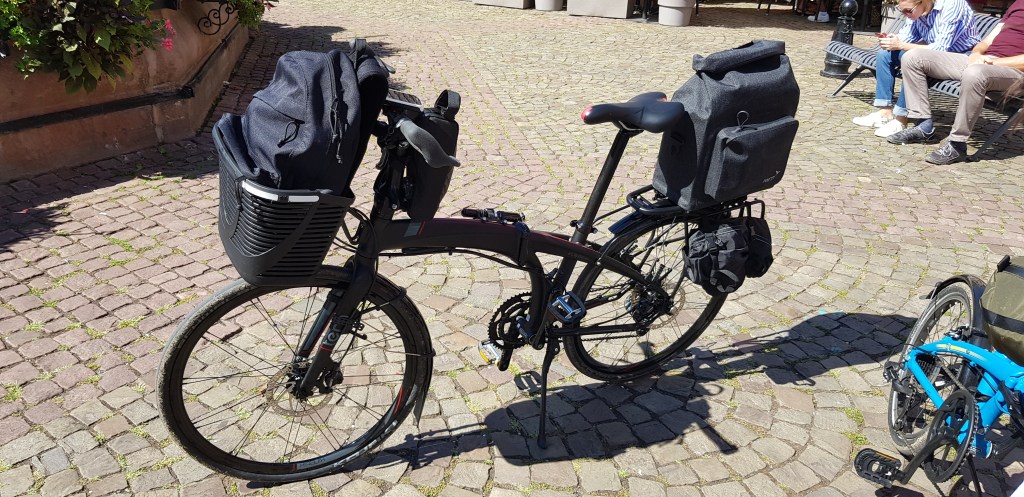
The basket clips on and off easily – and is held onto the frame rather than the handlebars, so has much less effect on your steering. It also enables you to switch different front mounts in at will. The waterproof rack-top bag is robust, neat and smart looking – and it allows you to fold the bike without removing it (unlike a pannier bag). The rear rack was a bit fiddly to install but works well. They are, all in all, just really well designed with the loaded commuter or tourer in mind. So well designed in fact, that I would have no hesitation using them for a trans-continental tour. Which makes some of the other design decisions like the crappy magnet seem so odd. I really enjoyed using the P20 as a touring bike because it was easy to load up, balance, ride and fold up again without loads of fiddling around with clips and racks. The C7 likewise worked really well in this regard. Check carefully on the Tern website to see which accessories work with what though. One to flag though – Tern’s carry cases are wicked expensive. The bag for the C7 is roughly £/€/$100. You can get a generic carry case for 20″ wheel bikes from Halfords for £/€/$20 that works just fine.
Living with the Fold
The C7 is reasonably portable – as a strongish, youngish man who does a fair bit of weight training, it doesn’t bother me too much but I still wouldn’t want to carry the folded C7 very far or very often. The weight isn’t the issue, more the shape and awkwardness of the burden. But it is absolutely manageable for quick changes on and off trains etc. You can also chuck the C7 in a carry bag like this one from Halfords, which makes life very much easier (though it takes a bit of feng shui to work out how to fit it in the bag and do up the zip.) The P20 on the other hand is a pig to carry when it is folded. It’s actually a lot easier to carry it unfolded! It isn’t heavy, just very awkward. It is large and there is no natural balance point or bit to grab it by. And Tern’s bag for it is giant, expensive and is designed more for storage than carrying. Swapping between trains and manhandling it through the London underground is at least as hard as carrying a normal bike would be. It is really, really not a pleasant experience. But – but – there we have it. It is at least an option. You can carry it on the London underground. As much as I hate the folded size of the P20, as much as I hate carrying it folded, that awkward fold has bailed me out of sticky situations so so many times. Getting the train from Milan airport to the centre of town? You can only do that with a folded bike. Getting from Central London to the airport? You can’t take full size bikes on the train. Those same trains are on strike? That’s fine, it goes (with a bit of begrudgement from other passengers) on the bus. German trains require you to have four separate pieces of paper to take a normal bike on a train! This is, I think, the folding market segment Tern must be after with the P20. People who basically never want to fold their bikes and wouldn’t really choose one, except sometimes, just sometimes they know they are going to end up in a situation or two where they need to fold it – where folding it is the difference between catching or missing a flight, or between a €4 train and a €100 taxi fare, or between zipping to a nice hotel just after midnight and spending 4 hours cycling along a cold dark highway to arrive at a shuttered hotel at 4am.
Flying with it
Ahhhhhhhh……again, this is somewhere where it all goes a bit wrong, especially for the P20. You may never plan to fly with your Tern, but if you do you may find it is barely any easier to fly with than a full size bike.
Airports are often annoying to get to at the best of times, by whatever means of transport. A lot of the world is also not well designed for bicycle transport. And when we get the two in combination – trying to get to an airport, on or with a bike – you can suddenly find yourself in logistics hell. Many a touring cyclist has enjoyed the special hell of trying to cycle along a highway at the end of a trip to the airport (there’s almost never a bike-friendly way to the airport – it’s usually a giant, fast highway). Once there, you have to lock up the bike, then go back to a strange town and trawl through various bike shops asking in a foreign language if you can have a bike box for free, and then somehow try to transport yourself and the giant empty box to the airport to package the bike up there. It really is a special kind of hell that I will write on in future. So the really great thing with a folding bike is that you can usually just ride to the station where whatever train or bus goes to the airport leaves from, and get to the airport relatively stress free. Though you still have to package it up. Now, if this a Brompton, this is super easy. You can just chuck it in any old bit of luggage and fly it as your normal checked bag, or if you’re really lucky maybe even as a carry on…..but not so the Tern. You actually need a massive cardboard box just like you would for a normal bike. The best solution I’ve found so far is to:
- Remove derailleur and any vulnerable accessories
- Flatten out any sticky-outie bits like the handlebars
- bubble wrap the life out of it
- zip tie/cable tie pipe insulation/pipe lagging all over the tubes
- chuck it in a giant, translucent plastic sack
- tape the sack closed
- wrap that bag in some rope to make it easier to carry.
You then just about have a transportable, packaged folding bike. To do this well (in the storage room of a Swiss hotel at midnight) actually took me nearly 2 hours, even with practice and some of the pipe insulation precut from a previous trip. With the C7, life was easier – I could put it in the carry-bag – but the first time I tried this, I didn’t bother taking off the rear derailleur. Inevitably, it bent. I was able to brute strength it back into position and it held for the rest of the trip, but it was still far from ideal.
At the end of the trip, getting the P20 to the airport still required booking an extra large taxi in the end anyway, though still marginally easier than flying with a normal bike in a cardboard box, I guess. But once you’re there – it isn’t likely to save you any fees or any time. Every time I’ve flown with it, it’s had to go as oversize luggage/special luggage. Which means more time at the airport, finding the oversize baggage area etc. Special mention for this: one time, all the oversize baggage from my flight failed to turn up at Milan airport. After standing around in confusion, then talking to some other passengers with oversize luggage, then some of those passengers shouting a lot in Italian it was established that oversized bags were going to arrive on a different flight 24 hours later. 3 hours wasted at the airport, and I had to go back out there the next day to get the damn thing again. No refunds, no travel expenses, no recourse. How I wished I’d got a smaller bike. Yet again, the large folded size effectively negated one of the main potential benefits of having a folding bike.


Who is it for? Is it for me? And is it for you?
That’s a question I have ended up without an answer to. I’m not sure if Tern know the answer either.
The easy part is the C7 – It’s a comfortable, user-friendly, well-appointed, practical folding bike for about half the price of a Brompton. The trade-off is that it is not as compact a fold, but it is arguably more capable in the bike department (ride quality, wider gearing, speed, comfort over rough terrain) and comes with things you would otherwise want to add like mudguards, and neat commuter friendly details like reflective tyres. It uses simple, user serviceable Shimano parts which all worked flawlessly, and can take Tern and other accessories without going all proprietary on everything. It’s no speed demon, but I was perfectly happy riding it briskly over a long day across the Alsace Wine Country – too busy enjoying the scenery to think about wanting more gears or speed.
But the P20 – well, I just can’t work it out. It’s a truly paradoxical hybrid: it’s not really the full-speed road bike Tern’s marketing department want it to be; and its a folding bike that exceeds common dimension limits for all the main places you’re likely to want to fold it.
On the one hand, it is brilliant, well-made and thought through – it’s one of the most capable and best riding flat-bar road bikes I’ve ridden, and it just so happens to fold. But to me, it’s still really hard to see who it could actually make sense for. If you really want a road bike substitute, flat handlebars, 26″ tyres and Tiagra groupsets won’t cut it. If you only want it to fold for neater storage at home….there are better ways to achieve that with a full size bike. If you want to fold it to carry or transport it elsewhere…get a different, smaller wheel model from Tern that actually fits in cars and on planes.
Maybe, just maybe, if I lived in Germany and took a lot of trains (where it is challenging to take a full-size bike), and I really really needed 20 gears it might tick a certain niche box – a box for technical compliance with rules about folding bikes on trains.
One guy I spoke to said his non-bike-friendly office didn’t have a secure bike parking facility and didn’t allow bikes inside the building – but they did allow him to put his folding bike under the desk. He reckoned my P20 would be perfect for some malicious compliance with that policy.
So that’s the P20 – ‘malicious compliance bike’.
Some alternatives
For the C7:
- Some of the Decathlon Tilt / Btwin range are similarly specced and more keenly priced
- There’s always Brompton
- Tern’s own range includes some pretty similar bikes at a lower price (e.g. the B7) that could fulfil much the same role in a commuting situation, or if you’ve got the budget for it, some much more interesting bikes if you’re after speed or a compact fold with some commuter-friendly tricks.
For the P20 – there aren’t a lot of direct competitors. Most of the time if you’re considering the P20 I would probably encourage people in the direction of the P10 instead. It just makes a lot more sense. Some actual competitors are:
Fellow full-size foldies:
- The Montague Fit might be the most direct competitor
- Change Bike (who intriguingly have a frame-only option)
- Airnimal bikes
Compact/dismountable bikes that don’t really fold down:
- Moulton’s unique break-apart frames
- Ritchey Breakaway (if it’s ever in stock)
- S&S Couplers
- Minivelos like from Ascent or Tokyobike
Other foldies:
- If you really want a Tern, do yourself a favour and get one with smaller wheels like the P10
- Just get a bloody Brompton already? Like everyone else already did.
 Common Sense Cycles
Leave a comment